
Choosing the right Custom O-Ring Kit Manufacturer is more than comparing prices or counting included pieces. It is a decision about material traceability, dimensional accuracy, storage quality, and application experience. Grand View Research identifies automotive, aerospace, and industrial equipment as major drivers of the global sealing products market. Its findings suggest continued demand for dependable sealing components in harsh operating environments. Parker Hannifin’s O-Ring Handbook also stresses that seal performance depends on compound selection, groove design, pressure, temperature, and installation conditions.
Robert Flitney, author of Seals and Sealing Handbook, offers a practical warning: “A seal is only as good as the conditions in which it operates.” That principle matters when evaluating a Custom O-Ring Kit Manufacturer. A kit may look complete in a clean catalog photograph. Yet, an unsuitable EPDM ring can swell in petroleum oil, while an incorrectly sized FKM ring may leak under repeated movement. Small details matter.
Ask for compound certifications, hardness data, batch identification, and dimensional inspection records. Check whether the supplier understands ISO 3601 requirements and can recommend materials for steam, hydraulic fluid, fuel, or outdoor exposure. A manufacturer with engineering support should explain its reasoning, not merely promise “premium quality.”
There is no perfect kit.
Even experienced buyers can overlook shelf life, packaging, or field temperature changes. The strongest choice combines documented quality, responsive technical advice, and proven production experience. This guide examines those factors closely, helping buyers judge manufacturers with evidence rather than attractive claims.
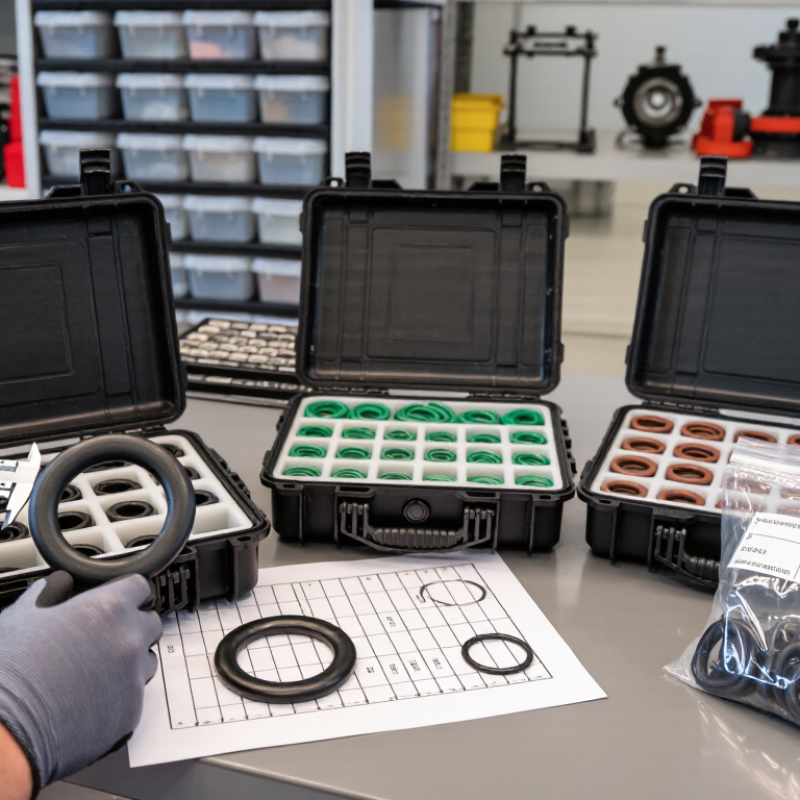
Choosing a custom O ring kit starts with a clear definition of the sealing job. Record the fluid, pressure, temperature, movement, and expected service life. A hydraulic valve may face 3,000 psi, while a food-processing fixture may need frequent cleaning. These conditions demand different materials, hardness levels, and surface finishes. Do not rely on a sample ring alone. Its size may match, but its compound may not.
Measure groove diameter, cross-section, squeeze, stretch, and tolerance with calibrated tools. Note whether the ring seals static or moving surfaces. Rotary shafts need attention to friction, heat, and abrasion. A static flange may prioritize compression and resistance to extrusion. Check exposure to oils, fuels, steam, cleaning agents, ozone, and sunlight. Small details matter. A ring exposed to hot water can swell, harden, or lose elasticity if the compound is poorly matched.
Give the manufacturer a written requirement sheet, drawings, test data, and failure history when available. Ask how materials are traced, inspected, and tested before packing. Reliable suppliers should explain batch control, dimensional inspection, and hardness verification clearly. Request samples for real application testing, not only a catalog check. I have seen promising seals fail after installation because the groove was overlooked. That mistake is avoidable, although field data can still surprise you. Leave room for revision when temperature cycles or cleaning methods change. Avoid paying for sizes your equipment will never use.

Typical continuous temperature ranges for commonly specified O-ring material families are shown below. Use the actual media, pressure, motion, installation dimensions, and temperature extremes of your application to confirm compound suitability before requesting a custom kit.
Reference ranges are approximate and can vary by compound formulation, exposure time, pressure, and service conditions. Final material selection should be validated against the manufacturer’s technical data and application requirements.
How to Choose the Best Custom O Ring Kit Manufacturer?
Material selection should begin with the working environment, not a supplier’s catalog. NBR suits many oil applications, while EPDM performs better with water, steam, and weather exposure. FKM handles higher temperatures, but it may fail in certain hot-water conditions. Ask for compound data, temperature limits, hardness ranges, and batch traceability. Material names are not enough.
Standards reveal manufacturing discipline. ISO 3601 addresses O-ring dimensions, tolerances, and quality requirements. ASTM D2000 helps identify rubber compounds through performance classifications. Request inspection records, compression-set results, tensile data, and certificates for every production lot. The U.S. Department of Energy reports that compressed-air leaks can waste 20–30% of system capacity. Poor sealing can become an energy problem, not merely a maintenance issue.
Customization should include more than printing a new size. A capable manufacturer can adjust cross-sections, groove fit, hardness, color coding, packaging, and material formulations. Ask whether prototypes use the same process as mass production. They should also explain mold tolerances and minimum order quantities clearly. Small details matter. I would not trust a supplier offering every compound without test evidence. My own evaluation would include sample aging, pressure cycling, and installation checks. Real equipment is less forgiving than a laboratory chart. Request drawings, sample labels, and failure-analysis reports before approving the kit.
| Evaluation Dimension | What to Evaluate | Recommended Benchmark or Evidence | Suggested Weight | Assessment |
|---|---|---|---|---|
| Base Elastomer Selection | Availability of compounds such as NBR, FKM, EPDM, silicone, and polyurethane for different media and temperature ranges. | The manufacturer should provide compound data sheets covering hardness, temperature range, fluid compatibility, compression set, and tensile properties. | 15% | Essential |
| Temperature Resistance | Continuous and intermittent operating temperatures supported by the selected compound. | Typical reference ranges include NBR approximately −30°C to +100°C, EPDM approximately −50°C to +150°C, silicone approximately −60°C to +200°C, and FKM approximately −20°C to +200°C. Verify the specific compound rather than relying on generic material names. | 10% | Critical |
| Chemical and Media Compatibility | Resistance to oils, fuels, hydraulic fluids, water, steam, acids, alkalis, refrigerants, or cleaning chemicals used in the application. | Request compatibility charts, immersion-test results, and defined limits for swelling, shrinkage, hardness change, and loss of tensile strength. | 15% | Critical |
| Material Traceability | Ability to trace each kit to a compound batch, production date, inspection record, and certificate of conformity. | Each kit should have a batch or lot number, material designation, hardness, dimensions, production date, and inspection status. | 8% | High Priority |
| Dimensional Standards | Use of recognized O-ring size and tolerance systems for inch and metric dimensions. | Confirm compliance with ISO 3601 or an agreed equivalent, including inside diameter, cross-section, dimensional tolerances, and visual acceptance criteria. | 10% | Critical |
| Compound Classification | Standardized identification of elastomer properties and performance categories. | For industrial applications, request ASTM D2000 or an equivalent compound classification, including hardness, tensile strength, elongation, and heat-aging requirements. | 7% | High Priority |
| Regulatory Compliance | Suitability for food contact, drinking water, medical, automotive, aerospace, or other regulated applications. | Depending on the application, verify relevant documentation such as FDA 21 CFR 177.2600, EU food-contact requirements, REACH, RoHS, or sector-specific approvals. Confirm that the documentation applies to the exact compound. | 10% | Application-Based |
| Customization Capability | Ability to develop custom sizes, non-standard cross-sections, special colors, coatings, lubricants, packaging, and labeling. | The supplier should provide drawing review, tolerance recommendations, prototype samples, design-for-sealing feedback, and formal approval procedures. | 10% | Essential |
| Quality Management System | Control of incoming materials, molding, trimming, inspection, nonconforming products, and corrective actions. | Look for a current ISO 9001 certificate, documented inspection plans, calibrated measuring equipment, process controls, and corrective-action records. | 8% | High Priority |
| Testing and Inspection | Inspection of dimensions, surface defects, hardness, tensile properties, compression set, and aging performance. | Require a quality report or certificate of conformity with sampling level, test method, acceptance limits, and actual results for the supplied batch. | 10% | Critical |
| Kit Organization and Packaging | Clear identification, protection from contamination, and practical organization for maintenance or field use. | Each compartment should identify size, material, hardness, quantity, and lot number. Packaging should protect elastomers from ozone, ultraviolet light, heat, moisture, and deformation. | 4% | Important |
| Lead Time and Supply Continuity | Prototype lead time, production capacity, minimum order quantity, repeat-order consistency, and emergency supply options. | Request a written schedule for sampling and production, capacity information, safety-stock options, and a documented change-notification process. | 3% | Important |
| Total Evaluation Weight | 100% | Use a documented scorecard | ||
Production quality should be verified on the factory floor, not assumed from a polished website. The ISO Survey 2022 recorded 1,265,216 ISO 9001 certificates across 189 countries and economies. That figure shows certification is common, but it does not guarantee excellent O rings. Ask whether the certificate covers mixing, molding, inspection, and packaging. Request batch records, material certificates, and calibration evidence. A reliable manufacturer should identify every compound, mold, and production lot.
Testing details reveal more than general quality claims. Check whether the supplier follows ISO 3601 for O ring dimensions and ASTM D1414 methods for rubber testing. Useful tests include hardness, tensile strength, elongation, compression set, dimensional accuracy, and leakage performance. For demanding applications, request temperature, pressure, chemical compatibility, and aging results. Ask for sample reports from recent production batches. Not just laboratory samples.
Certifications also need careful review. Automotive projects may require IATF 16949, while medical applications can require ISO 13485 and controlled documentation. Verify the certificate number, scope, expiration date, and issuing body independently. A certificate can be genuine yet irrelevant to your kit. That detail is often missed. An on-site or video audit should examine storage temperature, cleanliness, rejected parts, and traceability labels. No audit is perfect. However, a manufacturer that welcomes difficult questions usually provides stronger evidence than one offering only impressive claims.
Pricing is only one part of the purchasing decision. Ask for separate costs for tooling, samples, inspection, packaging, and freight. A low unit price may hide expensive mold charges or strict minimum orders. Compare quotes at three volumes, such as 100, 1,000, and 10,000 kits. Grand View Research reports continued growth in the global industrial seals market, near 4% annually through 2030. This growth can increase material demand and affect pricing. Lead time also needs detail. Request the sample date, production date, and shipping date separately. A supplier promising seven days may mean seven days after approval, not seven days after your purchase order.
Technical support separates a capable manufacturer from a simple reseller. Confirm compound traceability, hardness testing, dimensional inspection, and media-compatibility guidance. Ask whether engineers can review pressure, temperature, groove dimensions, and compression limits. The 2024 ISO Survey shows ISO 9001 remains widely adopted worldwide, but certification alone does not prove strong O-ring expertise. Review sample inspection reports instead. I would also test one complete kit before approving larger quantities. It costs more initially, yet prevents missing sizes in the field. Some buyers overlook replacement labeling; that mistake can create confusion during maintenance. A supplier should provide clear part identification, revision control, and practical technical responses. Fast replies are useful, but accurate replies matter more.
A dependable manufacturer should prove its capability through samples, not promises. Request O rings made from the exact material, hardness, and size required for your application. Check each sample with a calibrated caliper. Look for smooth surfaces, clean edges, and consistent dimensions. A simple compression test can reveal poor recovery or uneven molding. Ask for material data, inspection records, and batch traceability. Small details matter.
Reviews can show how a manufacturer handles real production problems. Read comments about delivery accuracy, sample quality, packaging, and technical support. Look for specific experiences rather than vague praise. Independent industry platforms may provide more balanced feedback. One positive review is not enough. Patterns are more useful. I would also ask for references from customers with similar sealing requirements, although some suppliers may not share them.
Communication often separates a capable partner from a difficult one. Send a clear drawing with tolerances, operating temperatures, fluid exposure, and expected quantities. Notice whether the manufacturer asks practical questions. Does the team explain material limits clearly? Does it confirm changes in writing? Try a small trial order before committing to high volumes. During one sample review, I underestimated the effect of surface finish on sealing performance. That mistake changed my checklist. A reliable supplier should accept such discussions, document corrections, and respond with evidence instead of defensiveness.
Contact
KYOCERA SGS Precision Tools, Inc.
(330) 686-5700
150 Marc Drive
Cuyahoga Falls, OH 44223
Products
Resources