Top 10 Types of Military Shields for Global Buyers
Military Shield procurement is becoming more specialized as defense, public-safety, and emergency-response teams face different protection requirements. A shield used at a checkpoint is not identical to one carried through a narrow corridor. Weight, viewing area, mobility, impact resistance, and storage space can change the buying decision.
The Stockholm International Peace Research Institute’s Trends in International Arms Transfers 2024 reported that global major-arms transfers remained highly uneven from 2020 to 2024. European arms imports rose sharply, while regional priorities continued to differ. This matters because buyers cannot rely on one universal shield design. Local terrain, mission rules, climate, and authorized use should guide selection.
Relevant technical evaluation also requires caution. The U.S. National Institute of Justice’s NIJ Standard-0115.00 provides a recognized framework for ballistic-resistant body armor testing, although it is not a complete standard for every shield format. Buyers should request independent laboratory results, test conditions, product traceability, and service-life information. Marketing claims alone are insufficient.
This guide reviews ten common types of Military Shield products for global buyers, including transparent ballistic shields, riot-control shields, blast-resistant designs, and vehicle-mounted protection systems. Each category has practical strengths and limitations. Some offer broad coverage but create fatigue. Others improve visibility but may reduce durability in harsh environments. The ranking is not absolute. Procurement teams should compare verified specifications, legal compliance, operator training, and after-sales support before approving any purchase. A small detail, such as a poorly positioned handle, can affect control during a stressful deployment. That detail is easy to overlook.
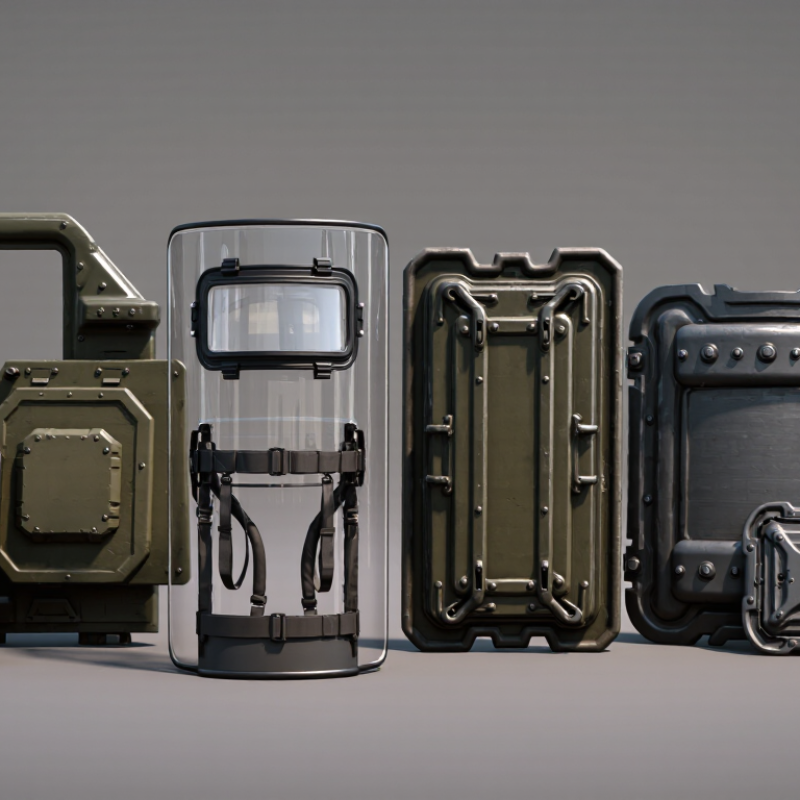
Military Shield Basics: Roles, Materials, and Protection Standards
Military shields differ by mission, not appearance. Ballistic shields protect against selected projectile threats, while crowd-control shields prioritize impact resistance, visibility, and maneuverability. Blast shields help reduce fragmentation and pressure effects, but they are not universal protection. Portable designs usually combine aramid, ultra-high-molecular-weight polyethylene, ceramic plates, steel, or layered transparent armor. Each material changes weight, thickness, durability, and viewing quality.
The National Institute of Justice’s 0108.01 standard describes ballistic-resistant materials and includes rifle-threat testing near 7.62 mm at approximately 2,780 feet per second for its highest listed type. However, that reference does not automatically certify every complete shield. Buyers should request the exact test report, projectile type, velocity, strike location, angle, and backing material. The NIJ 0101.07 framework also shows why updated testing matters. Threat labels alone can mislead. A shield may stop one round but perform poorly after repeated impacts, edge strikes, heat exposure, or damaged windows. Real field handling is less tidy than laboratory testing.
Tips: Match the shield to the task, team size, and transport limits. Check usable viewing area, grip comfort, replacement parts, and total carried weight. Ask for independent laboratory evidence, not only a sales specification. Protection standards vary across regions, and there is no single global shield rating. I would avoid treating “military-grade” as proof of performance. It is a description, not a test result.
How Military Shields Differ in Design, Mobility, and Defensive Purpose
Military shields differ sharply in design, mobility, and defensive purpose. A handheld ballistic shield prioritizes direct coverage, viewing ports, and manageable weight. A vehicle-mounted shield supports larger protected areas but sacrifices flexibility. Transparent crowd-control shields favor visibility and movement, while blast-resistant barriers emphasize standoff protection and structural strength.
Testing standards matter more than appearance. NIJ Standard-0108.01 evaluates ballistic-resistant materials against defined threats and impact velocities. It does not make every shield suitable for every mission. Buyers should request test scope, panel dimensions, weight, and mounting details. A thick panel may still create fatigue. That weakness is easy to overlook.
$2.443T SIPRI reported global military spending of $2.443 trillion in 2023, a 6.8% annual increase. This pressure encourages procurement teams to compare lifecycle cost, training burden, storage, and repair access. Lightweight modular systems can improve mobility, but joints and handles require careful inspection. Simple designs can be more dependable.
Field experience also exposes uncomfortable trade-offs. A shield that protects the torso may slow stair movement. A wider panel may block a teammate’s view. Operators need realistic drills, not showroom demonstrations. Independent laboratory records, documented quality control, and local compliance checks support more reliable purchasing decisions. Performance claims deserve verification.
Key Selection Factors for International Military Shield Buyers
Top 10 Types of Military Shields for Global Buyers
International buyers should begin with the operating environment, not the product image. Common options include ballistic shields, transparent shields, blast shields, riot-control shields, folding shields, portable shields, vehicle-mounted shields, modular shields, anti-stab shields, and lightweight team shields. Each type serves a different protective purpose. A shield for checkpoints may need visibility and long endurance. A vehicle-mounted model may require stronger brackets and vibration resistance.
Threat level, coverage, weight, and mobility deserve careful comparison. Buyers should request independent test reports linked to recognized protection standards. They should also verify materials, edge strength, viewing panels, handles, and replacement parts. In hot, humid regions, corrosion resistance matters. In cold climates, brittle materials can create unexpected problems. The strongest shield is not always the most useful. Excessive weight may reduce movement, communication, and user stamina. That trade-off is easy to underestimate.
Tips: Ask for realistic demonstrations, not only laboratory results. Test the shield with gloves, helmets, and protective clothing. Confirm storage dimensions, training requirements, warranty terms, and supply continuity. Check import rules and documentation in every destination market. A small pilot order can reveal handling problems before wider procurement. No design is perfect. Field feedback may expose weaknesses that specifications do not show. Procurement teams should record those lessons and revise their requirements when necessary.
Maintenance, Compliance, and Procurement Considerations for Defense Shields
Top 10 Types of Military Shields for Global Buyers
Maintenance, Compliance, and Procurement Considerations for Defense Shields
Selecting a defense shield requires more than comparing size and weight. Buyers may assess transparent shields, ballistic shields, blast-resistant panels, and crowd-management models. Each type serves a different protective purpose. Procurement teams should request tested performance data, material details, and service records. A shield that feels light in a warehouse may become tiring during prolonged use. Field trials matter.
Maintenance begins with disciplined inspection. Check handles, straps, fasteners, viewing panels, and edge seals after every deployment. Small cracks can spread under repeated impact. Clean transparent surfaces with approved solutions, not abrasive cloths. Store shields vertically in a dry, temperature-controlled area. Poor storage can warp composite materials. Replacement parts should remain traceable.
Compliance is equally important. Buyers must confirm applicable national standards, import controls, workplace rules, and documentation requirements. Testing reports should identify the laboratory, test method, date, and product configuration. Do not accept vague claims such as “military grade.” Procurement contracts should define inspection intervals, training obligations, warranty limits, and disposal procedures. A reliable supplier also explains limitations clearly. That builds trust.
A checklist can still miss real-world fatigue. Teams should review feedback from trained users and update procedures when evidence changes. Cost matters, but lifecycle value matters more. A cheaper shield may require earlier replacement, extra storage, or specialized servicing.
Top 10 Types of Military Shields for Global Buyers
Indicative mass ranges for maintenance, compliance, and procurement planning
How to read this chart: Shield mass is a practical procurement dimension because it affects mobility, operator fatigue, mounting requirements, transport, and maintenance handling. The ranges are indicative planning bands for commonly specified shield categories; actual values vary according to size, armor rating, materials, glazing, frame design, and accessories.
Compliance note: Military and law-enforcement shields do not share one universal global certification system. Tender documents should define the required ballistic or impact threat, test method, environmental conditioning, flame performance, transparency, ergonomic requirements, inspection process, and service-life criteria. Common procurement references may include applicable NIJ ballistic-material requirements and European EN 1522/EN 1523 classifications where relevant.